We are planning to have wide range of Open Canoes, Sit On Tops, and Sea Kayaks.
Keep and eye on our Facebook Event Page. for details as we confirm them.
Below are some pictures from last years Demo Day.


 I decided on a change of craft and took a Manta Ray 12 Angler. This was a great boat for this trip. Stable and comfortable and very easy to paddle. The start of the trip is easy on the River Isla. Flat and gives you a great chance to get used to your boat.

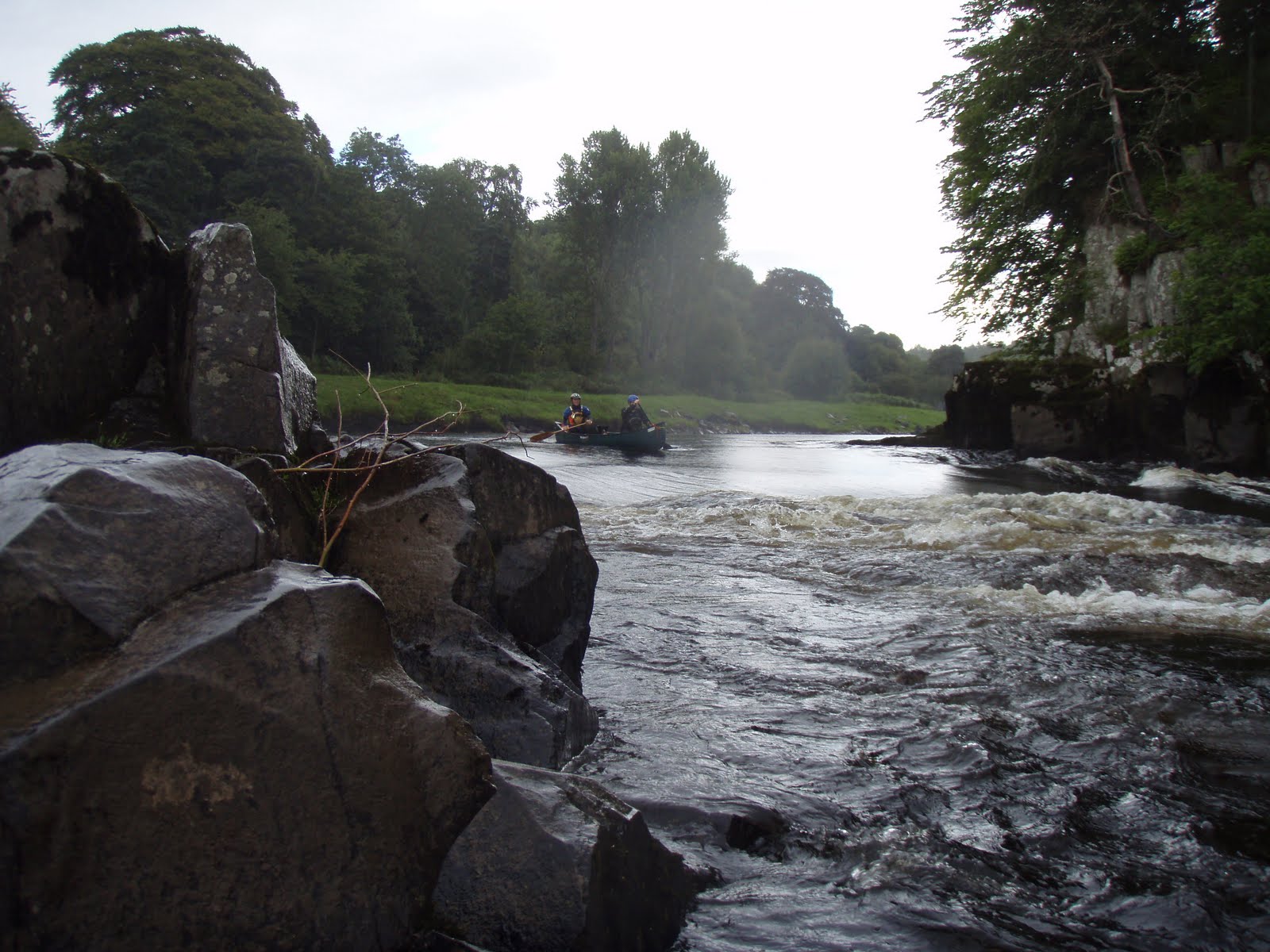 We saw some great wildlife on the way down the river. We saw a Heron and a Buzzard. We saw several fish rising always just out of reach of the fisherman. The highlight for me was seeing an Otter just above Campsie Linn.

 A wet finish to the trip. See you on the water.
Wood gunwales should be protected for storage by applying a coat of Gunwale Guard preservative. If the gunwales are dry or your climate is hot and humid, several coats may be necessary. In cold climates Gunwale Guard preservative is especially important to keep moisture out of the wood where it will freeze and expand. Be sure to protect under decks and other places where water may be trapped. Remove the deck plates on Royalex canoes to access the gunwales under them. On fiberglass or Kevlar canoes, this is a good time to tighten the screws along the gunwales.

Aluminum or vinyl gunwales, whether mounted on a Royalex, Royalex Lightweight, Fiberglass, or Kevlar hull are virtually maintenance free, and require no special attention prior to storage.
Seats and Thwarts
No special care is needed for these components before winter storage, except to tighten any loose bolts and touch up any chipped varnish.
Storage Position
The best canoe storage is upside-down in a cool, dry place. The canoe must be off the ground. A rack or sawhorses works well, but some protection can be obtained by using blocks. If you want to suspend the canoe from above, make sure the canoe's weight is resting evenly on the gunwales.
Do not store heavy objects on top of the canoe, and do not store a canoe on its side. Both will cause the hull to deform over time. If it will be exposed to wind, make sure your canoe is securely tied. Inside storage is preferred-it protects the hull from temperature extremes and exposure to rain or snow. Do not store our canoe a direct source of heat (e.g. a furnace): high temperatures are as detrimental as extreme cold.
If outside storage is necessary and a cover is desired, some precautions are needed. Make sure the cover will withstand snow loads or heavy rain. A plastic cover will protect the canoe from light precipitation and exposure, but do not allow the plastic to touch the hull. Leave the downwind end open for air circulation; moisture trapped between the cover and the canoe will discolor the hull. Some gray weathering of the gunwales will occur with outside storage.

Royalex Storage Information
If a Royalex canoe with wood gunwales will be stored in near or below freezing temperatures, the Royalex material, which has a high shrink coefficient, must be given ample room to contract. To do this, loosen all the inside gunwale screws several turns. Then remove the four screws on the outside gunwales on each side of the bow and stern.
Lift up the deck (the inside gunwales will still be attached), and from the ends of
the canoe sandwich a thin piece of wood between the gunwale/deck assembly and the top of the hull at both the bow and stern. Failure to perform this procedure can result in a cracked hull. In the spring, remove the pieces of wood, lower the gunwale/decks in place, replace the screws, and tighten all screws, including the inside gunwales.
Cold Cracks and Royalex canoes
What are "cold cracks"?
Royalex ® is a thermoformed composite material consisting of vinyl outer layers, interior ABS plastic layers and a foam core. It is an extremely durable material, capable of absorbing impacts and significant deflection without permanent damage.
However, it, as are most plastic materials, sensitive to temperature. Simply put, Royalex will contract when exposed to cold temperatures. This material property is what results in what are termed "cold cracks." Cold cracks are fractures of the material usually running perpendicular to the keel line of the canoe and terminating at the gunwale line. A canoe can experience a single cold crack or show a series of roughly parallel cracks over a portion of the hull. The majority of cold cracks occur towards the ends of the canoe.
Cold cracks result when the hull contracts in opposition to the gunwales remaining stable. As the hull contracts in opposition to the unchanging gunwales, stress eventually builds up that results in a sheer tear in the hull material, usually aligned with a fastener used to secure gunwale to hull.

How common are cold cracks?
Cold cracked hulls are actually quite rare (well less than 0.5% of Royalex hulls in existence) contrary to the amount of concern the problem receives amongst the paddling community. There are literally thousands of Royalex canoes that successfully winter over year after year in the northern United States and Canada without any problem. Some years the numbers are worse than others but a "bad" year, such as the winter of 2002-03 still only results in reports of 20-25 canoes suffering cold cracks. Most years we get reports of no more than 10.
At what temperature do cold cracks occur?
We know why the problem occurs, the bigger issue is there is no absolute way to predict when a hull will crack. There's no such thing as a predictable threshold of 100 or 150 that will result in a cold crack. Nor can we specify that X temperature for X number of days will create a cold crack.
We've had times when we've received reports of hulls cracking as far south as North Carolina while at the same time not hearing of any problems in Ontario or Maine. We've also heard of one person finding his boat cold-cracked while his neighbor, who stored his boat in a very similar manner did not have the problem. This is one of the most frustrating aspects of this issue, there's seemingly no rhyme or reason to it.
Over the years, we have gathered enough history to determine that a rapid temperature drop over a short period of time can result in cold cracks. If any conditions could be said to be cold crack conducive this would be it. However, there's no formula that specifies X degrees within an hour or a drop from X temperature to X temperature that will generate cold cracks.
Are certain types of gunwales more prone to cold cracking than others?
Yes, wood gunwaled canoes are most prone to cold cracking. This is due to any moisture contained in the wood rail will expand as it freezes, resulting in a gunwale that is actually expanding while the hull is contracting.
Synthetic gunwales are less prone than wood but it is certainly not unheard of for a canoe with aluminum gunwales to cold crack, particularly if a rapid drop in temperatures occurs. Cold cracks are least frequent in canoes with vinyl gunwales as the shrinkage coefficient of the gunwale is consistent with that of Royalex. However, most vinyl gunwales have an aluminum insert to provide the necessary stiffness for paddling and in most cases, the gunwale is affixed to the hull via screws or rivets driven through the aluminum insert. Thus, it's certainly not impossible to find a vinyl railed canoe with a cold crack.
How can I prevent cold cracks?
Honestly, it's almost impossible to entirely prevent them (short of storing your canoe in a heated area) primarily because the conditions at which they occur are so unpredictable. It is also possible that the older the canoe, the more prone to cold cracking it becomes as plastic becomes more brittle and less elastic over time.
Fortunately, there are ways you can minimize the likelihood of cold cracks. These range from storing your boat in a heated space to removing or loosening some of the fasteners in the gunwale. Here's what we recommend:
Canoes with Wooden Gunwales
1. Keep gunwales well oiled. A properly oiled gunwale will absorb minimal moisture and is more flexible and pliable and better able to work with changes in hull. The majority of cold cracks we see are on boats where the gunwales have not been properly maintained.
2. Remove screws from gunwales from each stem for 2'. Back screws out with Phillips head screwdriver. You can leave screws in outwale if preferred, so long as gunwale and hull move independently.
3. Lift up on inwales and deck and insert a ¼" thick wedge between gunwales and hull so that gunwales are lifted above sheer line of canoe. This will allow end of canoe to contract if temperatures dictate.
4. Loosen screws on next 2' of gunwales so that there is some play between hull and gunwales.
Avoid moving or hitting canoe when temperatures are below 20 degrees Farhen. Like most plastics, Royalex becomes more brittle when cold.
Canoes with riveted Aluminum Gunwales
Canoes with gunwales attached with rivets, there's not much to be done. If a strong cold front is predicted with significant and rapid temperature drop anticipated, you might be wise to
throw a couple of mover's style blanket pads over canoe to slow down rate of temperature
decrease.
Canoes with square drive fasteners (such as IQ Gunwale system)
1. Remove decks by releasing bolt in each side of deck.
2. Slide cover sleeve on outwale to reveal fasteners for 2' from each end of canoe.
3. Remove screws from end of canoe for 2' towards center.
4. Lift up on interior gunwales and slide ¼" thick wedge between gunwale and sheer line of hull to elevate gunwales above top of hull.
Are cold cracks covered under warranty?
No. Cold cracks are caused by subjecting the hull material to stress beyond its design limitations
and are thus excluded from warranty coverage.


 An A frame rig using two poles were lashed together and tied down front and rear. A knot was tied at the top with a crab to hoist the sail. (the tapr we used at lunch.)
 Once the sails were rigged and instructions given on how to drop the sail quickly in case of a gust it was onto the water and try them out.
 Pete had rigged a solo sail set up.
 Paul and Rikki had a two boat set up.


